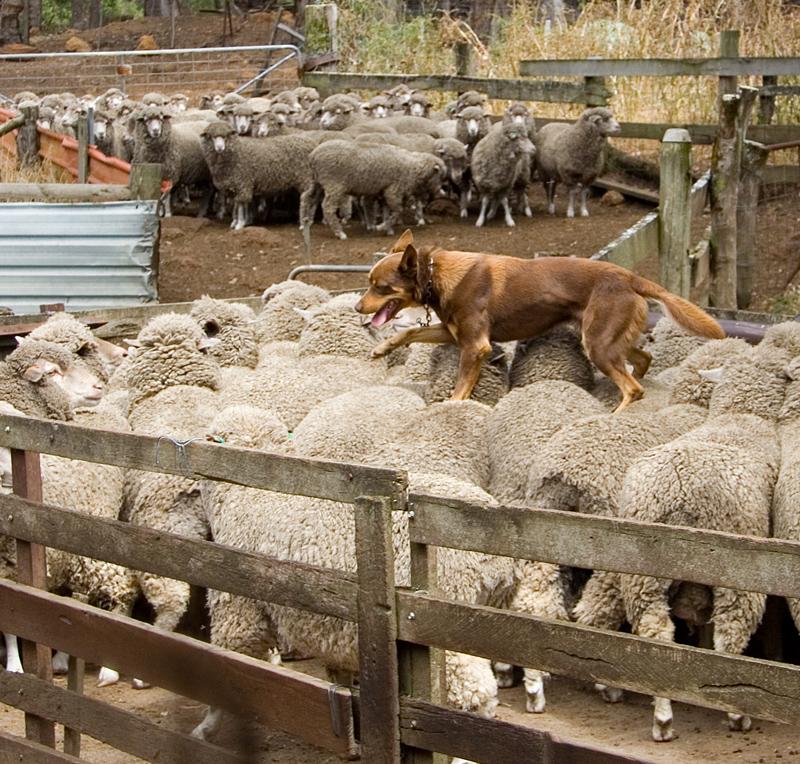
The kelpie in the photograph is at work, walking the backs of sheep. The dog you will actually present is often the same animal on a Tuesday morning: a little dusty, a little suspicious of a stranger’s hands, and already sore enough that someone has booked an hour. Preparation is not a scented-candle ritual. It is a file, a lead, a floor that is not lino, and a decision about who is in charge of the diagnosis.
This page sits on the canine chiropractic desk. The companion essay on what the hour looks like from the other side is what happens in a first animal chiropractic appointment. Read both if you have never stood in that room.
Before you book, do the veterinary work
A musculoskeletal visit is a poor first appointment for a limp. Have the regular veterinarian examine the dog. Ask whether they are comfortable with adjunctive manual therapy and whether they want to write a short note. In several Australian states, acts of veterinary science — including diagnosis — are restricted. A referral is not bureaucracy for its own sake. It is how you stay on the right side of veterinary referral and state practice acts.
Bring, or email ahead:
- the reason you are coming, in the owner’s words (“will not jump the ute,” “yelps when the collar tightens”)
- breed, age, work, and last lame day
- current medications and supplements
- radiographs or specialist letters, even as phone photos of the report
- any history of disc disease, seizures, surgery, or a collapsing episode
If the dog cannot rise, is knuckling, or has lost bladder control, do not prepare for a chiropractic visit. Prepare for an emergency clinic. Incontinence and spinal pain is that fork in the road.
Who should be in the room
The dog needs one calm handler. Two anxious adults and a child with a phone is not a team. If the dog is a working kelpie that only listens to one person on the property, that is the person who should hold the lead or the collar. A slip lead or a well-fitted flat collar is enough. A tight check chain is a poor idea on a dog that may already have a neck problem; see neck pain after play or a collar yank.
You stay. You watch the palpation. You ask what a finding means in ordinary language. The old Woollamia clinic on this domain, when dogs were seen on Willowford Road rather than in a paddock, ran as a consult, not a drop-off. That is still the right shape.
The room, the yard, the ute
Canine work is often done on a table or a non-slip mat in a clinic room. That was the model in the Shoalhaven years: a purpose-built space, instrument work available, no yanking of limbs. Mobile practitioners will come to a house or a shed. If they do, give them a flat, quiet surface, out of the wind, not on a wet concrete wash-down that will frighten a sore dog.
Do not ask a first-time visitor to assess a trial kelpie in a race full of sheep. The photograph is atmosphere. The appointment is not a demonstration.
If the practitioner travels — common outside capital cities — read mobile practitioners and regional Australia so the travel levy does not surprise you. Informal 2025 figures still put the consult itself somewhere around $90 to $180 before kilometres.
How to have the dog on the day
A usual walk, if the veterinarian has not restricted exercise. Nails that will not stab a stranger’s thigh. A coat that is not a mat of grass seeds if you can help it — palpation through a harvest coat is how findings get missed. No off-lead heroics at the beach on the morning of the visit so that the limp is “nice and obvious.” The dog should look like its week, not like a worse version of it.
If the dog is on pain relief, give the pain relief. A practitioner who wants the dog off medication to “see the true picture” is asking you to donate a painful hour to their curiosity. The true picture includes the treatment the veterinarian already chose.
Nervous dogs do better with a familiar mat and a shorter first visit than with a battle. Muzzles are allowed. They are not a moral failure. A basket muzzle that lets the dog pant is kinder than a wrestling match on a table.
What to ask while you are there
The questions to ask before you book list still applies in the room:
- What training sits behind the work — RMIT animal chiropractic or Box Hill animal biomechanical medicine after a primary degree, or something shorter?
- What exactly are you treating today?
- What should I see in the next 48 hours, and what would make you send me back to the vet tonight?
- Will you write to the referring veterinarian?
If the answers are vague, you can still pay for the hour and not rebook. How to find a qualified animal chiropractor is the longer consumer test, and Animal Biomechanical Professionals Australia is the membership list that replaced the old AVCA.
After you leave
A tired dog is common. A dog that is a little stiff that evening is common. A dog that cannot rise, that cries out, or that loses coordination is not a “healing response.” It is a reason to ring the veterinarian. Agree that sentence before you drive away.
Write down the home plan in your own words: rest, a short walk, no ute for a week, a stretch you were actually shown. If the plan contradicts the surgeon or the regular clinic, the regular clinic wins until the two practitioners speak.
What canine chiropractic is remains the definition if you are still deciding whether the word applies. Preparation will not make a thin qualification thicker, and it will not make a surgical spine safe. It will make an honest visit more useful, which is the most an owner can offer the hour.