The first brochure on this domain said the obvious thing: a horse’s spine takes sudden and repetitive load the way a person’s does, and owners notice it as a reluctance to pick up a lead, a short stride, or a saddle that will not sit. That sentence still holds for an Australian Stock Horse in a campdraft, a thoroughbred on the track at Randwick or Ascot, and the retired pony in a back paddock at Kangaroo Valley.
Equine chiropractic is a hands-on assessment of how the axial skeleton and the poll, wither and sacroiliac regions are moving. It is offered, in the version this journal will defend, by a person who already holds a veterinary, chiropractic or osteopathy degree and then completed a postgraduate animal programme. It is not a dental float, a lameness work-up, or a saddle-fit certificate. It is not a reason to skip the veterinarian.
What does an animal chiropractor do for a horse?
They come to the horse. That is the shape of most Australian equine work, and it was the shape of the old mobile list on this site — Nowra to Helensburgh, horses seen in the yard, dogs seen at Woollamia. The practitioner wants a flat place, a handler with a lead rope, and a history that includes the farrier, the saddle, the last lame day and the last veterinary visit.
They watch the horse walk and, if it is safe, trot in a straight line and on a small circle. They look at how the hind end comes under, whether the horse is holding a sacroiliac region, whether the neck is free to the bit or the hackamore. Then they use their hands along the poll, the cervical joints, the wither, the thoracic spine under the saddle, the lumbar region and the pelvis.
What follows is specific work on joints that are not moving as the practitioner expects, plus soft-tissue work, and a conversation you should be able to repeat to your veterinarian. The horse is not sedated for a routine visit. A horse that needs sedation to be touched is telling you something that may not belong in this hour.
For the wider map, use the equine chiropractic hub. If you are still at the noticing stage, read signs a horse needs a biomechanical assessment. If the horse is cold-backed, start with cold-backed horses explained and a veterinarian, not a booking.
Who may offer it, and what the Board actually says
The consumer test is the same as on the canine desk. Animal Biomechanical Professionals Australia succeeded the Australian Veterinary Chiropractic Association. Full members hold a veterinary, chiropractic or osteopathy degree plus the RMIT animal-chiropractic postgraduate pathway or the Box Hill Graduate Diploma in Animal Biomechanical Medicine.
The Chiropractic Board of Australia does not regulate practice on animals. “Chiropractor” is still a protected title for people. State veterinary practice acts restrict acts of veterinary science. A person who diagnoses a fracture, injects a hock, or tells you a wobbly horse is “just a C6-7” without a veterinarian is not being thorough. They are leaving their lane.
How to find a qualified animal chiropractor in Australia is the owner-facing test. The qualifications hub is the longer legal furniture.
Performance, saddles and other people’s jobs
Riders often arrive with a saddle that has been slipping, a horse that will not pick up the left lead, or a dressage test that fell apart in the canter transition. Those are real presentations. They have more than one cause. Performance horses, saddle fit and the spine is the essay that refuses to let the saddle or the back take all the blame. Farriers, saddlers and animal chiropractors is the team version of the same idea.
A chiropractic visit that never asks when the teeth were done, when the feet were last trimmed, or whether a saddle fitter has seen the horse this season is a visit that is pretending the spine is a closed system. It is not.
What the evidence will support
Limited is the honest word. Equine manual-therapy research is a thin file: small numbers, mixed methods, a lot of pressure-mat and rider-score outcomes that do not travel well. Extrapolation from human chiropractic and from veterinary physiotherapy is common and should be labelled as such. A horse that goes better the next day is a good afternoon. It is not a published trial.
This journal will not tell you that equine chiropractic prevents bowed tendons, fixes kissing spines on its own, or turns a club-footed paddock horse into an eventer. Racehorses, eventers and dressage is about different loads, not different miracles.
How much does it cost?
Informal 2025 and early 2026 reports from owners put a mobile equine visit somewhere between about $130 and $280, before travel. Travel is the line that surprises people: a practitioner coming out from a regional centre to a property at Milton, or west of Toowoomba, or up the Hunter, may charge a levy that rivals the consult. Some practitioners see several horses on the same road to make the kilometres make sense. Ask before they start the car.
None of those figures is a quote from a clinic that still answers this domain’s old phone number. That clinic is history. The fee shape is not.
When should I stop, or not start?
Do not start if the horse is down, ataxic, suddenly blind in one eye, blowing, febrile, or non-weight-bearing. Those are veterinary hours, and after a fall or slip, vet first is the trauma version. Stop if the horse is worse after a visit — more unwilling to go forward, a new hind-end weakness, a neck it will not bend. Stop if you are being sold a six-visit package before anyone has seen the animal, or if the practitioner wants you to discontinue the veterinarian’s pain plan.
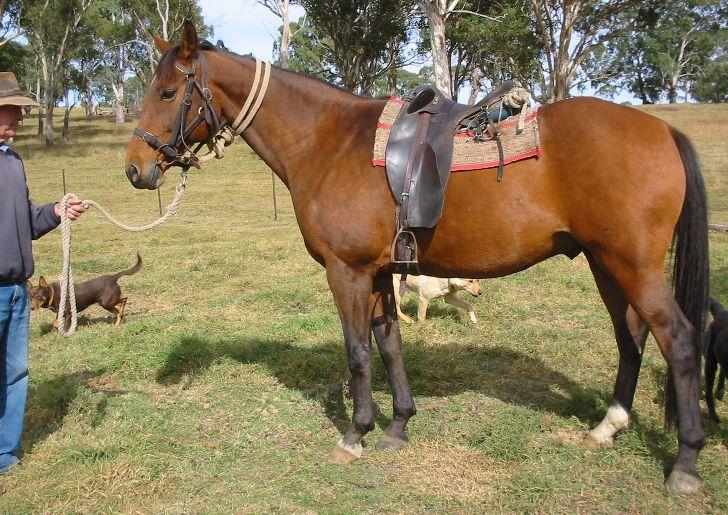
A stock horse in the photograph looks collected and well. Plenty of horses that need help do not. Equine chiropractic, done by people who actually trained for it, is a set of hands on a spine after a veterinarian has decided the horse is safe to treat. That is the whole definition. The rest is yards, lead ropes, and the discipline not to pretend otherwise.